




HİZMET
Myoma (uterine tumors)
Myoma arises from the smooth muscles of the uterus itself or its vessels, or from the connective tissue within it.
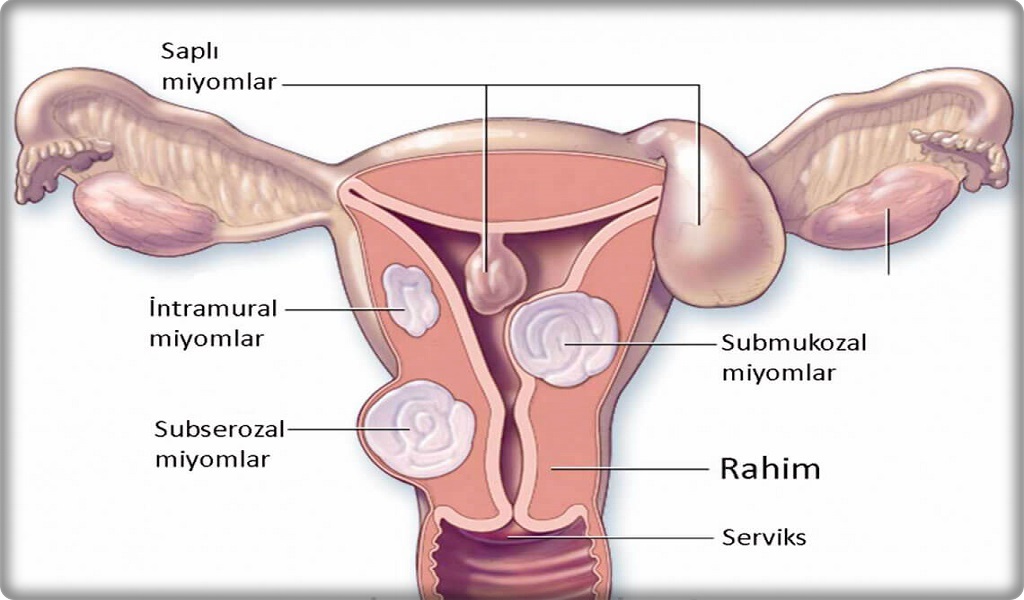
Myoma is a benign tumor that develops from the smooth muscles or connective tissue of the uterus itself or its vessels.
Risk Factors
The most important risk factors are; never having given birth, unopposed estrogen production due to lack of ovulation, obesity and race.
Due to some hereditary factors playing a role in the development of myomas,myomaOther women in the families of patients withmyomaThere is.myomaThey can be found in different parts of the uterus. Enlarges the uterus completelymyomaMyomas that extend into the uterine cavity (submucous myoma) and myomas that extend outside the uterine wallmyoma(subserous myoma) and myomas that both thicken the uterine wall and extend into the uterine cavity (intramural myoma) may develop. While some patients have a single myoma, others may have multiple myomas.
Myomas can reach very large diameters and in some cases grow large enough to form a tumor that extends to the navel. Since myomas that develop towards the uterine cavity increase the surface of the uterus and cause irregular uterine wall shedding, they may show symptoms such as increased, prolonged or irregular bleeding.
If myomas grow rapidly, their blood vessel supply is disrupted andmyomaDegenerative changes occur in the These degenerative changes manifest themselves especially with pain.
Some myomas are attached to the uterine wall with a thin stalk, and due to the rotation of this stalk around itself (torsion), their nutrition is disrupted and they may cause complaints of pain and, in more advanced cases, even symptoms that require urgent hospital admission. Some myomas that develop from the uterine cavity pass through the cervix and extend towards the vagina (myoma born into the vagina). Myomas, which are quite common in women, may not always cause symptoms.
must be treated
Therefore allmyomaIt is not necessary to treat myomas; in most cases, regular gynecological check-ups every 6-12 months are sufficient.myomaSurgical intervention is required for myomas in cases where there is bleeding, pain, pressure on the bladder or anus due to menopause, the myoma grows despite menopause, the myoma rotates around its own stem, myoma born into the vagina, the myoma enlarges the uterus more than the size of a three-month pregnancy, and infertility. The treatment of myomas is surgery.
myomaBy suppressing female hormones and creating a menopause before surgical treatmentmyomaSome hormonal drugs that cause diameter reduction can be used.
The effect of these drugs on shrinking myomas is temporary. In patients where fertility is desired to be preserved, the uterus is mostly preserved and onlymyomacan be removed (myomectomy).
This procedure can be performed using open surgery or endoscopic methods (laparoscopy), taking into account the location and size of the myoma and the general condition of the patient.
In patients who are past childbearing age or do not want more children, and in cases of extremely large myomas where it is not possible to preserve the uterus, the entire uterus may need to be removed.
If women whose uterus is removed are of childbearing age and there is no abnormality in their ovaries, the ovaries are not removed during the surgery and these patients do not experience menopausal symptoms after the surgery.
The probability of developing cancer in myomas (leomyosarcoma) is very low (around 1-3 in 1000).