




SAĞLIK REHBERİ
Wishing for a smoke-free world
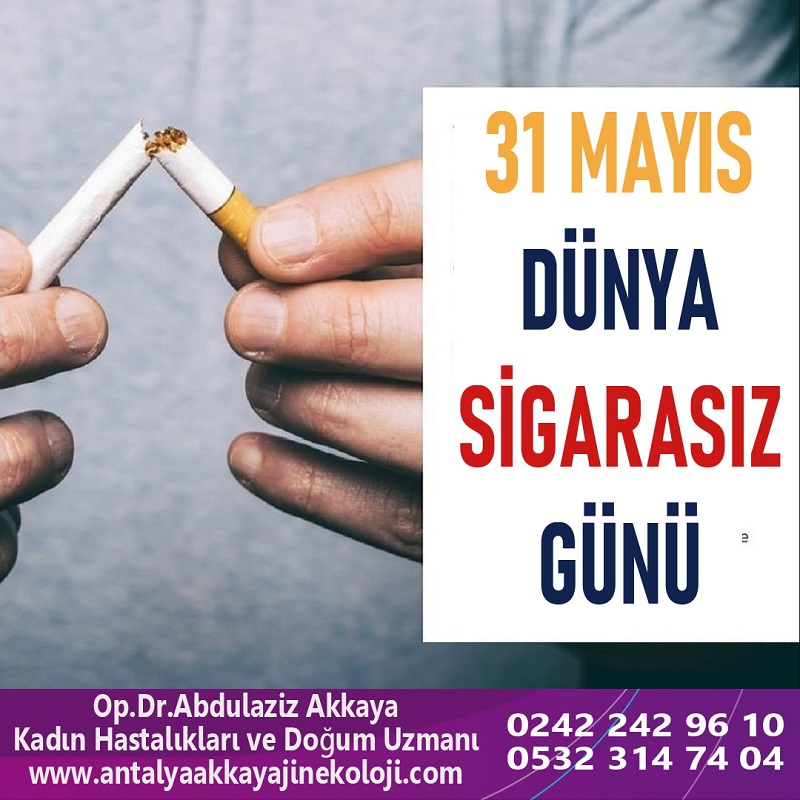
Making a statement on the occasion of 31 May World No Tobacco Day, Gynecology and Obstetrics Specialist Op. Dr. Abdulaziz Akkaya,

Making a statement on the occasion of 31 May World No Tobacco Day, Gynecology and Obstetrics Specialist Op. Dr. Abdulaziz Akkaya drew attention to the health hazards of smoking specific to women.
“In studies comparing smokers and non-smokers, it has been determined that the rate of infertility is higher, fertility is lower and the time to pregnancy is longer in women who smoke.” said Op. Dr. Abdulaziz Akkaya, World No Tobacco Day (WNTD), World No Tobacco Day, World No Tobacco Day or World No Tobacco Day is an important day celebrated every year on 31 May by the member states of the World Health Organization (WHO) all over the world since 1987.
5.4 million deaths each year
It is aimed to draw attention to the global health effects of tobacco use, which has become widespread and causes the death of 5.4 million people worldwide every year.
Tobacco use is the most important preventable cause of disease in the world and is responsible for 10% of adult deaths. Every year, 6 million people in the world die from a smoking-related disease, and more than 600,000 people die because they are exposed to cigarette smoke smoked by others, even though they do not smoke themselves. If precautions are not taken, annual deaths will reach 8 million in 2030. 80% of these deaths will occur in underdeveloped and developing countries. Approximately 15 million people smoke in our country and approximately 150 000 people die from a smoking-related disease every year.
Health Harms of Smoking Specific to Women
Nowadays, there are many lists prepared based on the scientifically proven health hazards of smoking. Cancers, cardiovascular and respiratory diseases constitute the majority of these lists, which are valid for both genders. It is known that many of these damages are more severe in women than in men. For example, smoking is more effective in terms of lung cancer in women, and adenocarcinomas are more common in women who smoke than in men who smoke. Even worse, smoking has additional and additional harms specific to women, such as menstrual disorders, reproductive function disorders, cervical cancer, and maternal deaths.The Effect of Smoking on Female Reproductive Functions and Its Relationship with Infertility:
Infertility is defined as the failure of pregnancy to occur despite couples wanting a child for a year and having regular sexual intercourse without using contraception. It is accepted that the prevalence of smoking in women of reproductive age is 25%. It is emphasized in the literature that the amount of cigarettes smoked daily and the duration of smoking can directly affect fertility and reproductive ability in women of reproductive age. The incidence of infertility in women who smoke is ten times higher than in non-smokers. It is stated that smoking causes infertility in 13% of women.
In studies comparing smoking and non-smoking women; It has been determined that the rate of infertility is higher, fertility is lower, and the time to pregnancy is longer in women who smoke. The above-mentioned problems are more common especially in women who smoke more than 20 cigarettes a day.
In a study, it was determined that women who actively smoke did not have problems getting pregnant depending on the number of cigarettes they smoked in a day, and these women became pregnant at least 3-12 months later compared to non-smoking women. In addition, a woman's exposure to second-hand smoke due to her husband's smoking also negatively affects women's reproductive functions.
In women who smoke, the decrease in the level of estrogen hormone secreted by the ovaries causes a decrease in the functions of the ovaries and increases the level of the hormone (FSH) that enables the development of follicle cells in the ovaries. Hormone levels (FSH) that enable egg cell development are significantly higher in women who smoke than in non-smokers. In a study, the level of the hormone (FSH) that enables egg cell development was 66% higher in active smokers than in non-smokers; It is stated that it is 39% higher in those who are passively exposed to cigarette smoke.
The effects of a woman's smoking or exposure to cigarette smoke on her reproductive functions are as follows:
1. Prolongation of the pregnancy period (average 3 -12 months), 2. Primary or secondary infertility, 3. Entering menopause at an earlier age (on average two years earlier), 4. Increased risk of spontaneous miscarriage (spontaneous abortion), 5. Premature labor, 6. Risk of giving birth to a low birth weight baby (the baby's birth weight is 150-300 g less on average), 7. Depletion of follicles in the ovaries (having problems getting pregnant/early menopause) 8. Menstrual disorders and shortening of the interval between menstrual cycles, 9. It may cause risk factors such as bladder and cervical cancer.
In addition to trachea, bronchus and lung cancer in women who smoke; Cervix, bladder, larynx, mouth-pharynx, kidney and pancreatic cancers are also more common.Cardiovascular and chronic lung diseases are also more common in women who smoke.
The death rate from coronary heart disease was found to be twice as high in smokers compared to non-smoking women, and the risk of death from chronic lung disease was 12 times higher. In the USA, it is estimated that 90% of deaths from chronic lung disease in women occur due to smoking.
Another issue related to cardiovascular diseases in women is the interaction of oral contraceptive use with smoking. If oral contraceptive users smoke, the risk of coronary heart and peripheral vascular diseases is higher.
Even if women themselves do not smoke; Another dimension of the issue is that a person is at risk of health problems such as lung cancer and cardiovascular system diseases as a result of being passively affected by his/her spouse's smoking at home.
Menstrual disorders and infertility problems are more common in women who smoke. It is also known that women who smoke enter menopause earlier.
The harms of smoking are not limited to women who smoke. The incidence of placenta previa, abruptio placenta, membrane rupture, miscarriage, stillbirth, premature birth, low birth weight and congenital malformations is higher in women who smoke, and smoking negatively affects the children of smokers, starting from the womb.
The weight of babies of mothers who smoked during pregnancy is 200-250 grams lower on average. Smoking also causes decrease in breast milk. Smoking is responsible for 24,500 low birth weights, 71,900 premature births, and 200,000 asthma attacks each year in the United States alone. Likewise, sudden infant death is more common in children of mothers who smoke.
It is also known that children who grow up in smoking homes are more likely to contract respiratory infections.
In addition, mothers and fathers are "role models" for their children. Children and teenagers who grow up in smoking homes are much more likely to start smoking.
It is known that smokers' skin ages prematurely, their voices become deeper, and osteoporosis is more common in smokers.
 Op.Dr.Abdulaziz Akkaya
Gynecology and Obstetrics Specialist
Comments and questions
There are no comments on this article yet.