




SAĞLIK REHBERİ
Uterus and Urinary Bladder Prolapse
Loss of the properties of the sexual organs and the ligaments that fix these organs in the abdomen

uterine prolapse, bladder prolapse, prolapse of the last part of the large intestine and complaints of urinary incontinence are seen together.
It is the displacement of the sexual organs downwards towards the vagina due to the loss of the properties of the ligaments that fix these organs in the abdomen. Generally, not only the uterus, but also the urinary bladder and the last part of the large intestine, located just in front and behind it, sag along with the uterus.
Normally, these organs can move only to a limited extent, thanks to the ligaments that hold them. As age progresses and especially as the number of births increases, these ligaments lose their flexibility and thus may cause the genital organs to sag into the vagina. Sometimes the prolapse is so pronounced that the woman can feel the cervix at the entrance to the vagina with her hand. Sometimes the uterus may even protrude outside the vagina in neglected cases.
Urinary Bladder ProlapseUrinary bladder prolapse; It is the name given to the bulging of the urinary bladder, which is adjacent to the front wall of the vagina, inside the vagina. This situation causes the woman to feel the bulging bladder inside the vagina with her hand, especially in situations that increase intra-abdominal pressure such as coughing, sneezing, or lifting a heavy object. This complaint is often, but not always, accompanied by urinary incontinence. In its mildest form, urinary incontinence occurs only when coughing, sneezing and straining. As the severity of prolapse increases, urinary incontinence occurs during situations such as laughing, sexual intercourse, and even standing.
In advanced cases, urinary bladder prolapse causes the angle between the bladder and the tube called urethra to be disrupted, thus causing the complaint of urinary incontinence. In the most advanced and very rare cases, urine cannot be retained at all and the urine coming into the bladder is discharged directly out of the bladder without being stored there.
Uterine Prolapse
When uterine prolapse occurs alone, it causes the woman to feel pain and fullness in the lower area, especially when standing, coughing, sneezing and straining.
Prolapse of the rectum (the last part of the large intestine) is the bulging of the rectum, which is adjacent to the back wall of the vagina, towards the vagina. Although rectal prolapse does not cause any special problems in most cases, it may cause constipation problems. Another problem for women who have sagging problems in their genital organs is that the tears that occur during difficult births cause complaints of vaginal enlargement. This situation may cause the woman to have problems in sexual life with her husband, and the couple may not be able to enjoy sexual life as before.
Sagging genital organs is especially seen in women who have had multiple and difficult births. Prolonged births result in the ligaments that hold the genital organs in place becoming longer, tearing in some areas, and thus reducing their function of holding the organs in place. Prolapse is much less common in women who have given birth by cesarean section and in women who have never given birth.
Genital organ prolapses are rarely seen alone. oftenuterine prolapse, bladder prolapse, prolapse of the last part of the large intestine and complaints of urinary incontinence are seen together.
How to Diagnose?
genital organ prolapseIt can be detected incidentally in a woman who has no problems, or it is diagnosed when sagging is easily seen during the gynecological examination of a woman who frequently experiences urinary incontinence or a "feeling of fullness in the lower area".
Treatment Methods
Treatment of uterine prolapse varies depending on the woman's age, the degree of the disease, the woman's general health condition and whether she wants to have children later. The development of this problem in the future can be prevented, at least partially, by doing regular Kegel exercises, which are exercises that contract the muscles around the vagina and perineum. In case of genital organ prolapse in a woman who has completed her family, the treatment method generally consists of removing the uterus from the vagina and narrowing the vagina by removing the excess on the front and back vaginal walls. If women who have undergone vaginal tightening surgery become pregnant, they must have a caesarean section instead of a normal birth.
urinary incontinenceDifferent surgical techniques may need to be used to treat the problem. In a woman of reproductive age who is still considering giving birth or who does not accept hysterectomy even if she has completed her family, the enlargement repair, that is, narrowing of the vagina, is performed by removing only the excess tissue on the front and back vaginal walls without removing the uterus.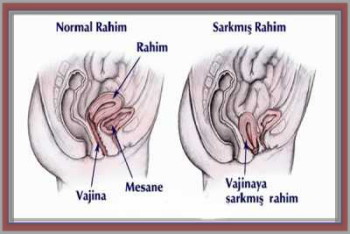
In this way, the complaints of women who complain of vaginal enlargement after birth will decrease and they will be more satisfied with their sexual life than before. Vaginal tightening operation is called vaginoplasty in medicine.
Evidentuterine prolapseIn this case, it is possible to reach the ligaments that hold the uterus in place through the abdomen and pull these ligaments upwards, thus preventing the uterus from being removed. However, it should be known that pull-up operations do not last very long. Depending on the type of operation performed and the technique of the surgeon, the risk of recurrence may occur within 3-5 years.
Very rarely, for women who do not want to have their uterus removed even though they have children, or who want to give birth to another child, or for patients who are too old and in poor general condition to even undergo a hysterectomy, devices called pessaries, which are inserted into the vagina and hold the uterus up, can also be used instead of the operation, but such treatments are applied in very special cases. Nowadays, in women who have completed their families, removing the uterus, which has no function beyond carrying a child, is the most rational form of treatment for prolapse.
Op.Dr.Abdulaziz Akkaya Gynecology and Obstetrics Specialist
Comments and questions
Rahim veya mesane sarkması varsa ilk adım nedir?
Baskı hissi, idrar yakınmaları ve günlük yaşam etkisi muayenede değerlendirilir. Herkes için aynı tedavi gerekmez; uygun seçenekleri ve beklentilerinizi konuşun.