




SAĞLIK REHBERİ

Women are more at risk

Gynecology and Obstetrics Specialist Op.Dr. Abdulaziz Akkaya's statement titled "Women are more at risk" appeared in the press.
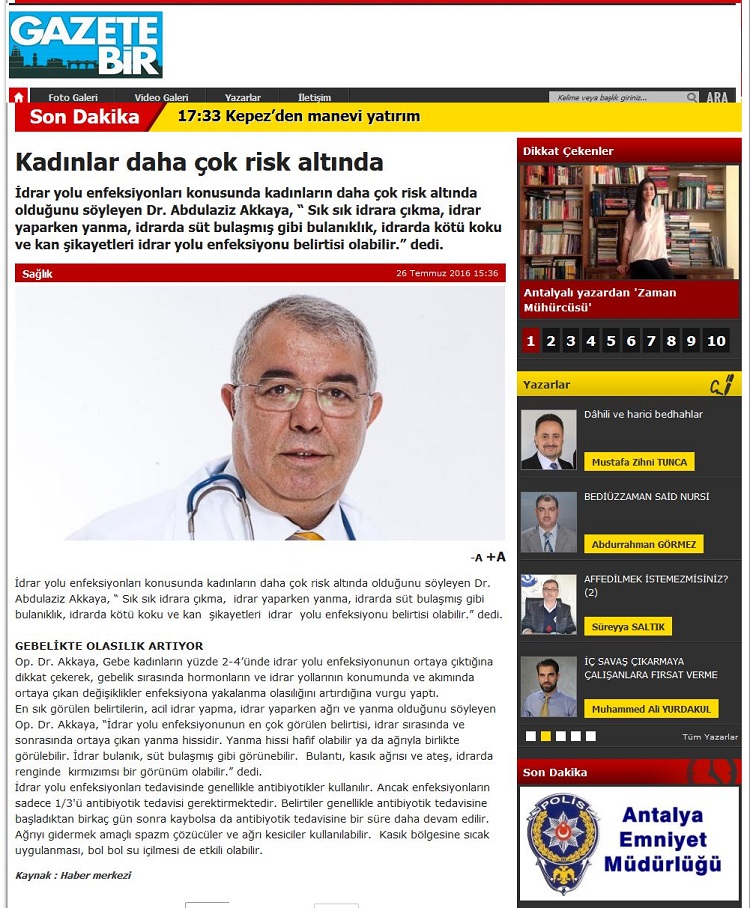
Women are more at risk

Gynecology and Obstetrics Specialist Op.Dr. Abdulaziz Akkaya's statement titled "Women are more at risk" appeared in the press.


Women are more at risk

Dr. says that women are more at risk for urinary tract infections. Abdulaziz Akkaya: "Frequent urination, burning sensation while urinating, turbidity in the urine as if it were contaminated with milk, bad odor and blood in the urine may be symptoms of urinary tract infection." he said.

THE POSSIBILITY INCREASES DURING PREGNANCY

Op. Dr. Akkaya pointed out that urinary tract infection occurs in 2-4 percent of pregnant women, and emphasized that changes in the location and flow of hormones and the urinary tract during pregnancy increase the possibility of getting an infection.

Op. states that the most common symptoms are urgent urination, pain and burning during urination. Dr. Akkaya said, "The most common symptom of urinary tract infection is the burning sensation that occurs during and after urination. The burning sensation may be mild or accompanied by pain. The urine may appear cloudy and milky. Nausea, groin pain and fever may occur, and the urine may have a reddish appearance." he said.

Antibiotics are usually used to treat urinary tract infections. However, only 1/3 of infections require antibiotic treatment. Although symptoms usually disappear a few days after starting antibiotic treatment, antibiotic treatment is continued for a while. Antispasmodics and analgesics can be used to relieve pain.  Applying heat to the groin area and drinking plenty of water may also be effective.

İlgili okumalar

\n\n

Op. Dr. Abdulaziz Akkaya portresi

Editor

Op. Dr. Abdulaziz Akkaya

Specialist in gynaecology and obstetrics

This article is for general information and does not replace an examination or treatment advice. Speak with your doctor about health questions.

Comments and questions

There are no comments on this article yet.

Write a comment

Comments are reviewed before publication. Please do not include personal health information. Book an appointment for medical questions.

Your name will be partly hidden when published.

Contact

Start with
reliable information.

Güllük Caddesi Fatih Apt. No:3/9, 07230 Muratpaşa, Antalya, Türkiye

\n

QUESTIONS AND ANSWERS

Explore all questions

For general information. It does not replace personal assessment or diagnosis.

01Why is postpartum checkup important?

Postpartum interviews provide evaluation of recovery, bleeding, blood pressure, mental health, breastfeeding, birth control, and chronic diseases. Get emergency help for severe bleeding, shortness of breath, or chest pain.

02When is vaginal discharge considered normal?

Clear or white discharge with no foul odor, the amount of which may vary throughout the cycle, can often be physiological. If there is a bad odor, yellow-green color, itching, burning, pain or bleeding, an examination is required.

03Is ovarian cyst dangerous?

Many cysts are benign and temporary. Appearance, size, age and symptoms determine the follow-up approach. Sudden and severe unilateral pain, nausea, or feeling faint may require urgent evaluation.

04When should menstrual irregularity be investigated?

Significant changes in the cycle, absence of menstruation for three months or longer, frequent bleeding, the possibility of pregnancy, or accompanying pain and weight change may require evaluation.

05Is spotting normal while using birth control pills?

Breakthrough bleeding may occur, especially in the first months; However, bleeding that persists, increases, or is accompanied by other symptoms should be evaluated. The decision to stop or change the medication should not be made without consulting a physician.

English
TürkçeDeutschРусский