




SAĞLIK REHBERİ
Women's worst dream
Obstetrics and Gynecology Specialist Op.Dr.Abdulaziz Akkaya on Akdeniz Headline News Site on 18.12.2016

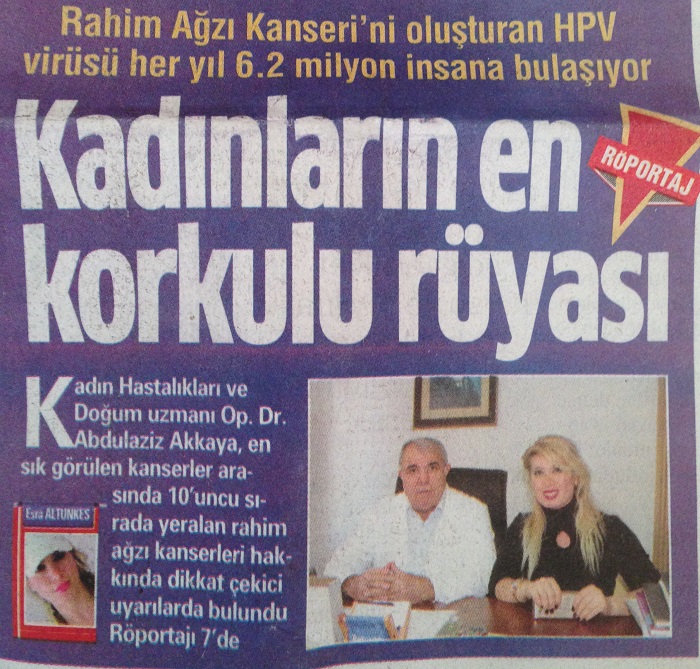
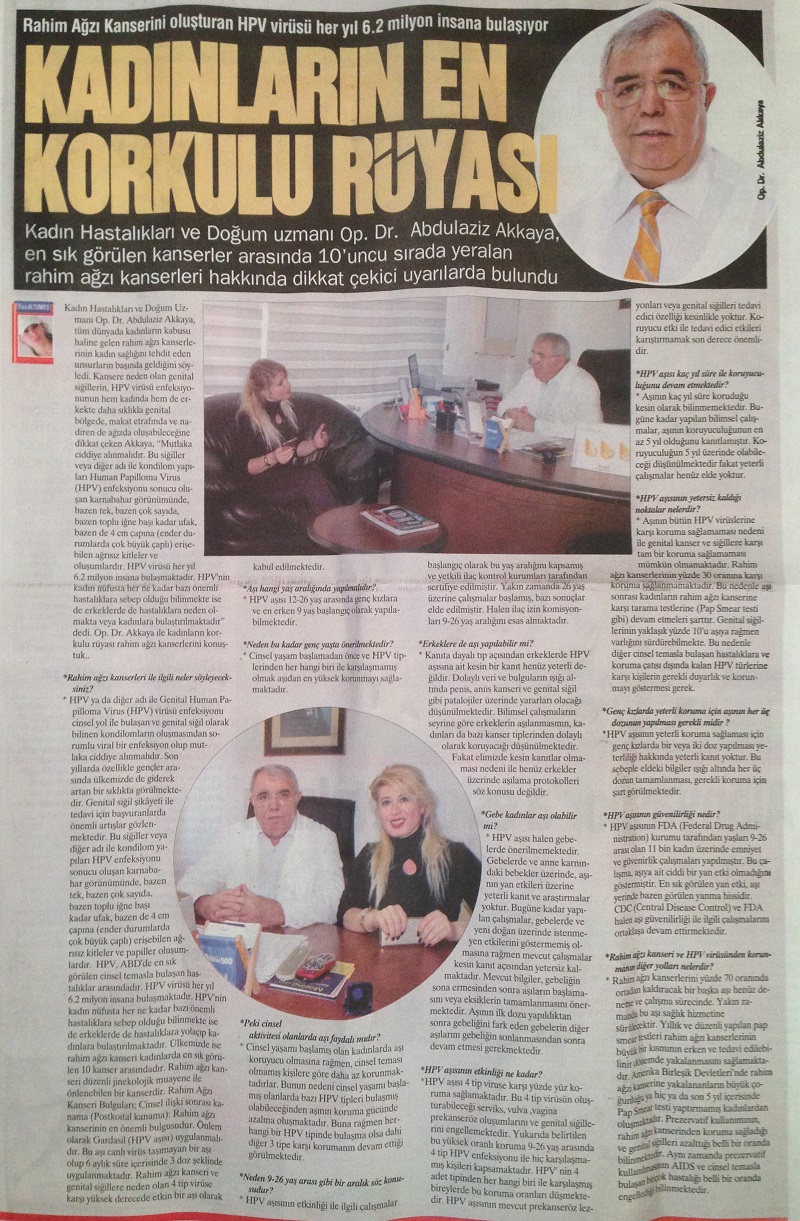
The interview of Gynecology and Obstetrics Specialist Op.Dr.Abdulaziz Akkaya with Journalist Esra Altunkes was published on Akdeniz Headline News Site on 18.12.2016.
Women's worst dream
HPV virus, which causes cervical cancer, infects 6.2 million people every year
Gynecology and Obstetrics specialist Op. Dr. Abdulaziz Akkaya made remarkable warnings about cervical cancer, which ranks 10th among the most common cancers.
Gynecology and Obstetrics Specialist Op. Dr. Abdulaziz Akkaya said that cervical cancer, which has become a nightmare for women all over the world, is one of the main threats to women's health. Pointing out that cancer-causing genital warts and HPV virus infection can occur more frequently in the genital area, around the anus and rarely in the mouth in both men and women, Akkaya said, "It must be taken seriously. These warts, or condyloma structures, as they are also known, have the cauliflower appearance resulting from Human Papilloma Virus (HPV) infection, sometimes single, sometimes numerous, sometimes as small as a pinhead, and sometimes reaching a diameter of 4 cm (in rare cases, very large diameters). "They are painless masses and formations. The HPV virus infects 6.2 million people every year. Although HPV is known to cause some serious diseases in the female population, it also causes diseases in men or is transmitted to women." Op. Dr. We talked to Akkaya about cervical cancer, which is a nightmare for women.
*What do you have to say about cervical cancer?
* HPV or Genital Human Papilloma Virus (HPV) virus infection is a sexually transmitted viral infection responsible for the formation of condylomas known as genital warts and should be taken seriously. In recent years, it has been seen with increasing frequency in our country, especially among young people. There is a significant increase in the number of people applying for treatment with complaints of genital warts. These warts, or condyloma structures as they are also known, are painless masses and papillary formations that appear as a result of HPV infection, with a cauliflower appearance, sometimes single, sometimes multiple, sometimes as small as a pin head, and sometimes up to 4 cm in diameter (in rare cases, very large diameter). HPV is among the most common sexually transmitted diseases in the United States. The HPV virus infects 6.2 million people every year. Although HPV is known to cause some important diseases in the female population, it also causes diseases in men and is transmitted to women. In our country, cervical cancer is among the 10 most common cancers in women. Cervical cancer is a cancer that can be prevented by regular gynecological examination. Cervical Cancer Findings; Bleeding after sexual intercourse (Postcoital bleeding): It is the most important finding of cervical cancer. Gardasil (HPV vaccine) should be administered as a precaution. This vaccine does not contain live virus and is administered in 3 doses over a 6-month period. It is considered a highly effective vaccine against 4 types of viruses that cause cervical cancer and genital warts.
*At what age range should the vaccine be administered?
* HPV vaccine can be administered to young girls between the ages of 12-26, starting at the age of 9 at the earliest.
*Why is it recommended at such a young age?
* Having not been exposed to any of the HPV types before starting sexual life provides the highest protection from the vaccine.
*So, is the vaccine beneficial for those who have sexual activity?
* Although the vaccine is protective for women who have started their sexual life, they are less protected than those who have not had sexual contact. This is because some HPV types may be infected in those who have started their sexual life, thus reducing the protective power of the vaccine. Despite this, it appears that even if there is infection with any HPV type, protection against the other 3 types continues.
*Why is there a range between the ages of 9-26?
* Studies on the effectiveness of the HPV vaccine initially covered this age range and were certified by authorized drug control institutions. Recently, studies on 26-year-olds have started and some results have been obtained. Currently, drug permit commissions are based on the age range of 9-26.
*Can men also be vaccinated?
* In terms of evidence-based medicine, there is not yet sufficient definitive evidence for HPV vaccination in men. In the light of indirect data and findings, it is thought that it will have benefits on pathologies such as penis, anus cancer and genital warts. According to the course of scientific studies, it is thought that vaccination of men will indirectly protect women from some types of cancer. However, since we do not have definitive evidence, there are no vaccination protocols for men yet.
*Can pregnant women get vaccinated?
* HPV vaccine is still not recommended for pregnant women. There is not enough evidence and research on the side effects of the vaccine on pregnant women and unborn babies. Although studies conducted to date have not shown any undesirable effects on pregnant women and newborns, current studies are insufficient in terms of definitive evidence. Current information recommends starting or completing vaccinations after the end of pregnancy. Pregnant women who realize they are pregnant after the first dose of the vaccine should continue their other vaccinations after the end of pregnancy.
*How effective is the HPV vaccine?
*HPV vaccine provides 100% protection against 4 types of viruses. It prevents precancerous formations of the cervix, vulva, vagina and genital warts that can be caused by these 4 types of viruses. This high rate of protection mentioned above covers people between the ages of 9-26 who have never encountered 4 types of HPV infection. These protection rates decrease in individuals who have been exposed to any of the 4 types of HPV. The HPV vaccine has absolutely no curative properties for existing precancerous lesions or genital warts. It is extremely important not to confuse protective effects with therapeutic effects.
*How many years does the HPV vaccine continue to provide protection?
* It is not known exactly how long the vaccine protects. Scientific studies conducted to date have proven that the vaccine's protection is at least 5 years. It is thought that the protection may be over 5 years, but sufficient studies are not yet available.
*What are the inadequacies of the HPV vaccine?
* Since the vaccine does not provide protection against all HPV viruses, it is not possible to provide complete protection against genital cancer and warts. There is no protection against 30 percent of cervical cancers. For this reason, it is essential for women to continue screening tests (such as Pap Smear test) against cervical cancer after vaccination. Approximately 10 percent of genital warts can persist despite vaccination. For this reason, people need to show the necessary sensitivity and protection against other sexually transmitted diseases and HPV types that are outside the protection framework.
*Is it necessary to administer all three doses of the vaccine for adequate protection in young girls?
*There is insufficient evidence that one or two doses of the HPV vaccine are sufficient to provide adequate protection in young girls. For this reason, in the light of the available information, completing all three doses is considered essential for the necessary protection.
*What is the reliability of the HPV vaccine?
* Safety and reliability studies of the HPV vaccine were conducted by the FDA (Federal Drug Administration) on 11 thousand women aged between 9 and 26. This study showed that there were no serious side effects of the vaccine. The most common side effect is a burning sensation that sometimes occurs at the injection site. CDC (Central Disease Control) and FDA are currently continuing their joint studies on vaccine safety.
*What are other ways to protect against cervical cancer and HPV virus?
* Another vaccine that will eliminate cervical cancer by 70 percent is still in the trial and study process. This vaccine will soon be released into healthcare. Annual and regular pap smear tests ensure that most cervical cancers are detected at an early and treatable stage. The majority of people diagnosed with cervical cancer in the United States are women who have either never had a Pap Smear test or have not had one in the last 5 years. It is known to a certain extent that condom use provides protection against cervical cancer and reduces genital warts. It is also known that using condoms prevents AIDS and many sexually transmitted diseases to a certain extent.
Comments and questions
There are no comments on this article yet.